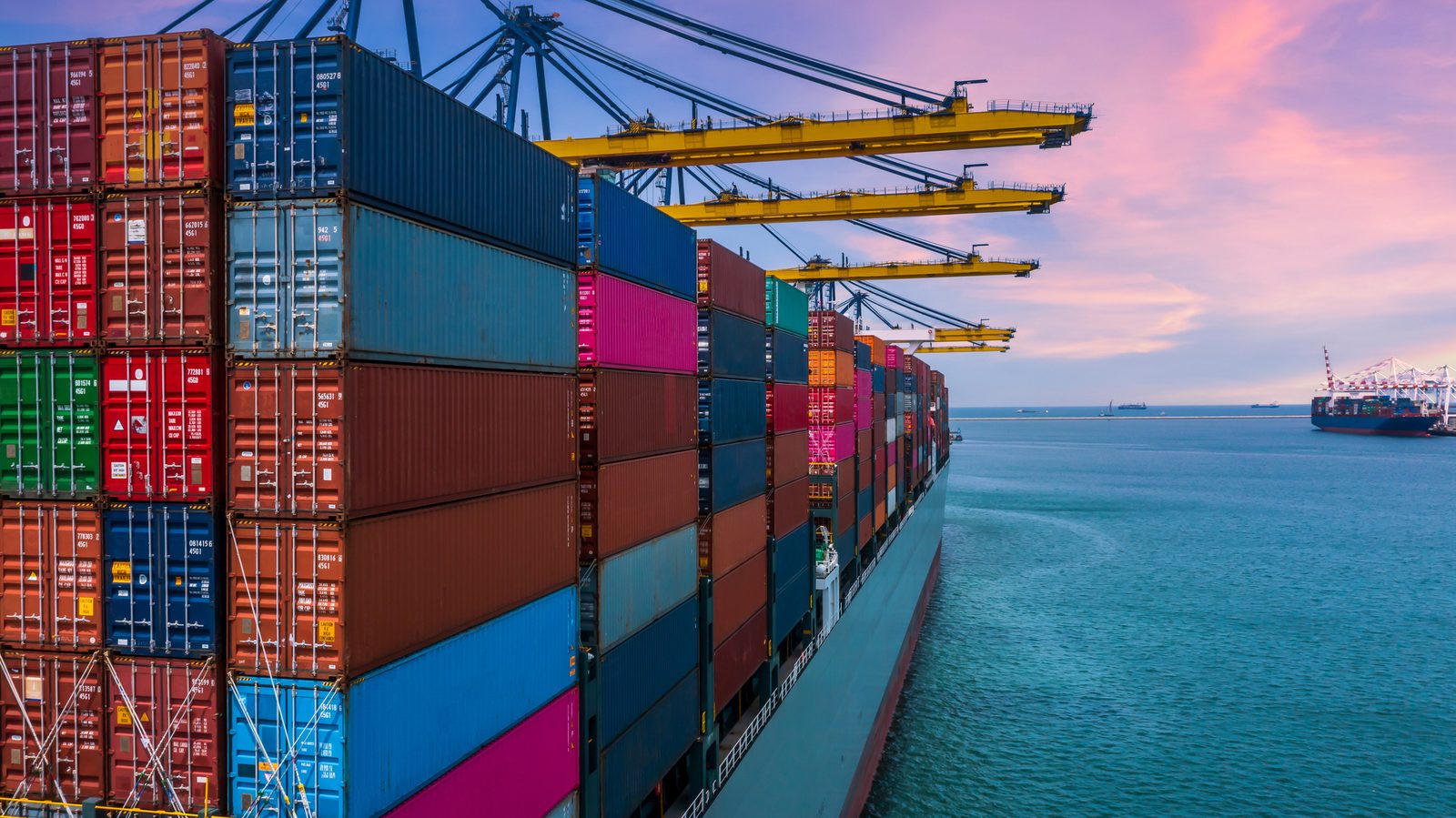
Freight is the part of importing where the headline number is least useful. A quote of "$1,800 to your port" can become $3,400 by the time the container is on your yard, and none of the additions are dishonest — they were simply not in the quote.
Here is how the modes actually compare, and what to ask for so the numbers are comparable.
| Mode | Best when | Typical transit | Cost profile |
|---|---|---|---|
| Sea FCL | You can fill 20ft / 40ft / 40HQ | 18–45 days | Lowest per unit |
| Sea LCL | Under ~15 CBM | 25–50 days | Low, but per-CBM rates rise fast |
| Air | High value density or urgency | 3–8 days | 5–15× sea per kg |
| Rail | Central Asia, Europe | 18–30 days | Between sea and air |
LCL is charged per cubic metre (or per tonne, whichever is greater — "revenue tonne"). It looks cheap at 3 CBM and stops looking cheap surprisingly early.
As a rough rule: above 12–15 CBM, price a 20ft container as well. A 20ft holds about 28 CBM usable. Buyers frequently discover that shipping 15 CBM as LCL costs nearly the same as a 20ft container they could have half-filled — and the container is faster, handled less, and far less likely to arrive damaged.
LCL cargo is unloaded, sorted and reloaded at a consolidation warehouse at both ends. Every handling point is a chance for damage. This is the cost nobody puts in the quote.
| Container | Usable volume | Practical payload |
|---|---|---|
| 20ft standard | ~28 CBM | ~21–25 tonnes |
| 40ft standard | ~58 CBM | ~26 tonnes |
| 40ft high cube | ~68 CBM | ~26 tonnes |
Note the asymmetry: a 40HQ gives you roughly 2.4× the volume of a 20ft but barely more weight. For dense cargo — tile, hardware, machinery — you will hit the weight limit long before the volume limit, and a 20ft is the right box. For light bulky cargo — furniture, packaging, plastics — the 40HQ is dramatically better value.
Ask for these explicitly, or your comparison is meaningless:
The single most useful thing you can ask any forwarder is: "What is the all-in landed cost per unit at my warehouse door?" If they cannot answer, you do not yet have a quote.
EXW — you take responsibility at the factory gate. Lowest headline, most work. FOB — the supplier delivers to the port and clears export; you handle freight onward. The most common and usually the most sensible for a buyer who wants control. CIF — the supplier arranges freight and insurance to your port, but you inherit the destination charges they chose, which can be inflated. DDP — everything included to your door. Simplest, and you pay for that simplicity.
Our general advice: FOB for containers, DDP for small or first shipments where you want one number and no surprises.
Rarely on paper, sometimes in reality. Air wins when the goods are valuable relative to their weight, when the selling season is short, or when the alternative is missing a launch. It also wins on working capital: five days on a plane instead of forty on a ship is thirty-five days of cash you are not financing.
One constraint worth flagging: products with lithium batteries are restricted cargo. They can travel by air and sea, but only with correct UN38.3 documentation and packing. Discovering this at the airport is an expensive way to learn it.
If you buy from four suppliers, the default is four shipments, four sets of documents and four clearance events. Consolidating them into one container at origin usually saves 20–40% of total freight and, more importantly, collapses four opportunities for something to go wrong into one.
This is standard work for us: goods collected into our Guangdong warehouse, checked, repacked where needed, loaded together and shipped under a single bill of lading.
Send a photo, a drawing, a link or a sample reference by email — you will have a considered reply, usually within one working day.